
How Wasel.ma deployed 3 AI agents to run an entire marketing agency
Wasel.ma was managing dozens of marketing clients simultaneously with a human team that was overwhelmed. Opuslon designed a multi-agent system where each agent plays a precise role — strategy, creation, commercial — with human oversight on critical validations.
The challenge
Wasel.ma is a digital marketing agency managing dozens of clients simultaneously: content strategy, creation, social media publishing, commercial follow-up, and reporting.
As the client portfolio grew, the team could no longer maintain quality and cadence without hiring — an expensive option that wouldn't solve the root problem: repetitive, time-consuming tasks consuming the most creative profiles' time.
Leadership wanted to scale without hiring, maintain quality, and keep control over what was published on behalf of clients.
The Opuslon solution
Opuslon designed an orchestrated multi-agent system: three specialized AI agents working in sequence, each receiving the previous agent's output.
Each agent has limited access to the data it needs (CRM, analytics, client drive) per its role — no agent accesses the full system. Critical validations (final publishing, email sending) require human confirmation.
Everything is connected to the agency's existing tools via APIs — without changing the human team's workflows.
Multi-agent system architecture
Here are the 4 diagrams that describe exactly how the system works — from strategic decision to publication, through shared memory and the learning loop.
The strategy — how the agent decides what to publish
Every Monday, the strategist agent synthesizes 3 input types: the brand brief (objectives, KPIs, audience), live data (Search Console, last week's results, competitor moves), and market trends (Morocco events, seasonality, web search). It produces a complete weekly brief with exact topics, channels, dates and CTAs — which you approve on Telegram before execution.
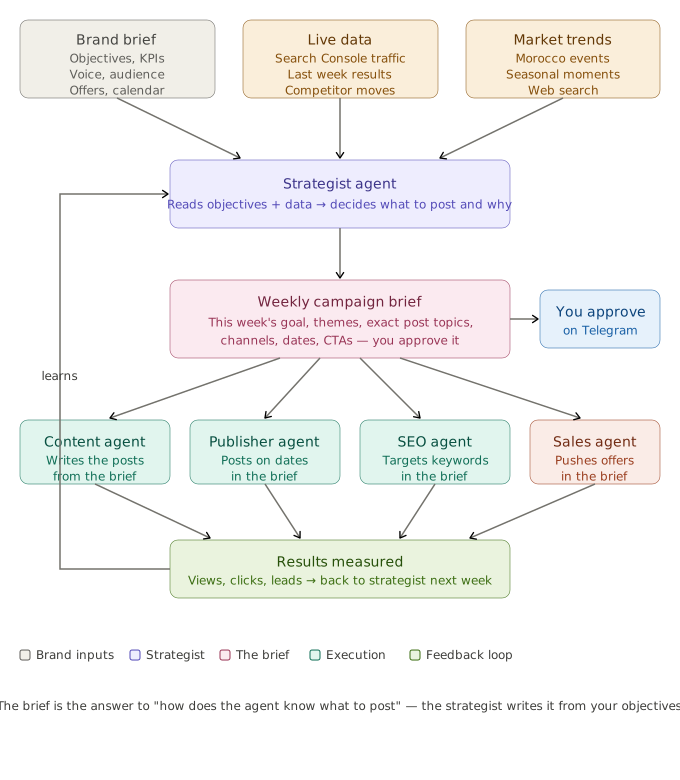
The brief is the answer to "how does the agent know what to post" — it decides from your objectives, not its own initiative. You keep control over direction, agents handle execution.
Shared memory — how agents stay informed without talking to each other
No agent calls another agent directly. All read and write into a shared Obsidian vault — simple Markdown files: BRAND_BRIEF.md, CAMPAIGN_BRIEF.md, RESULTS.md, SEO_REPORT.md, CRM.md. You see everything each agent has read or written, in real time, directly in the Obsidian app.
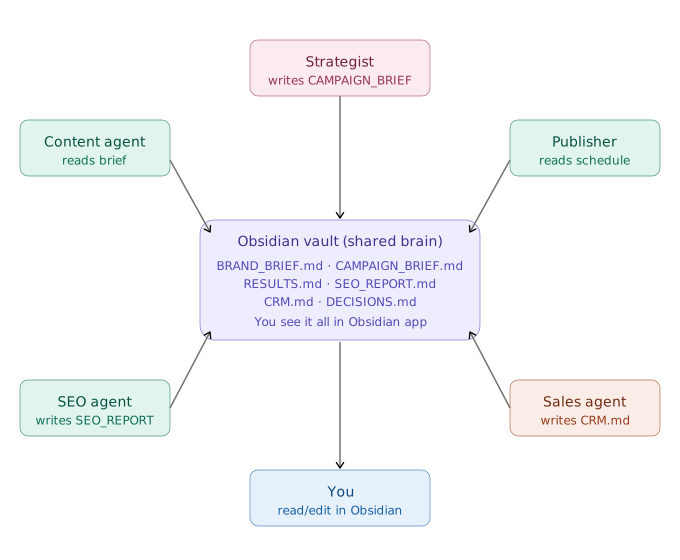
This design has a key security advantage: if one agent is compromised, it can't interrogate the others. It sees only the files its role authorizes. The vault is your complete audit trail.
The learning loop — the system improves every week
Each execution agent (SEO, Publisher, Sales) finishes its work by writing a report file into the vault. The following Monday, the strategist reads all these files before deciding on the next week. Last week's views, clicks, and leads directly inform the next brief — with no manual entry.
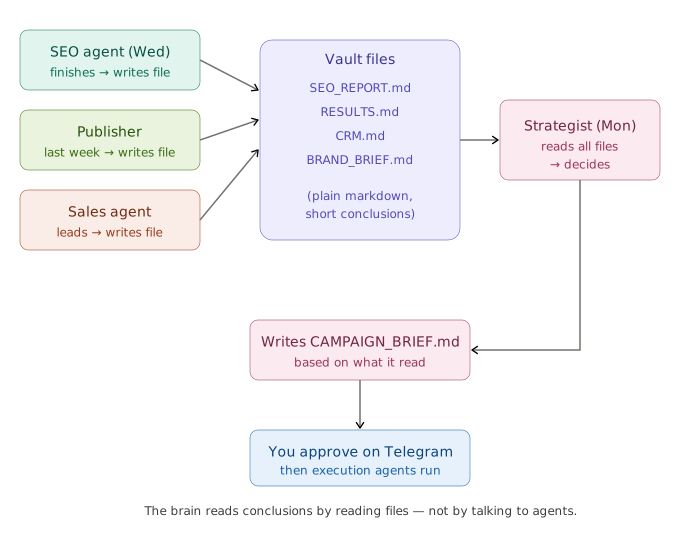
The system doesn't make random decisions. Each brief is a reasoned response to what happened the previous week. The longer the system runs, the more data the strategist has to decide — without you having to manually explain context.
The full architecture — two brains, controlled costs
Technical view of the full system. Marketing brain (left): strategist (smart model, once/week) → brief → BRAND_IDENTITY.md → content agent (cheap model) → Publisher routes to LinkedIn, Instagram, Facebook, Blog with the right tone per platform → consistent image generation. Sales brain (right): Mailer agent that triages every incoming email — auto-reply for FAQ/pricing/info, escalates to you on Telegram for hot leads and demo requests.
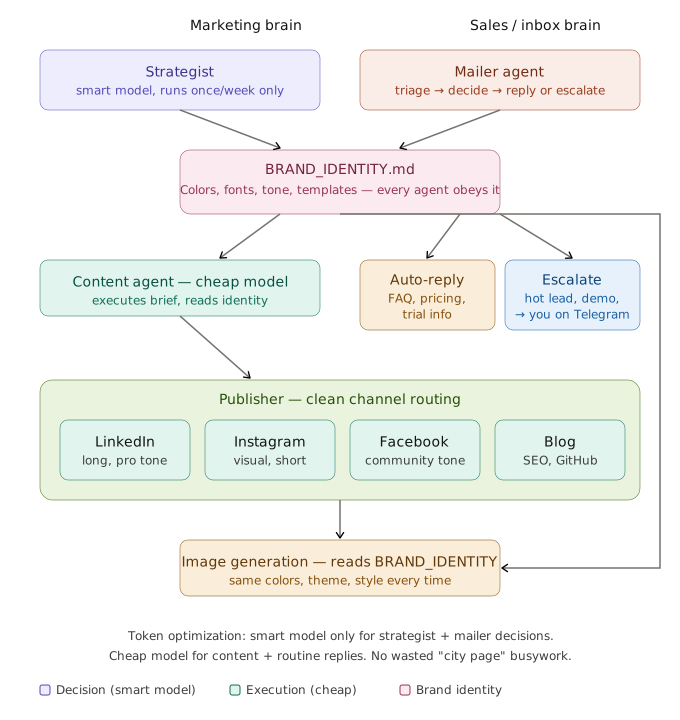
The token optimization is deliberate: the smart model (expensive) is used only for high-stakes decisions — the strategist once a week, the mailer to qualify leads. Execution agents (content, Publisher, FAQ replies) use a cheap model. Result: controlled infrastructure cost without sacrificing decision quality.
No agent has access to another agent's data. Each agent sees only the files of its perimeter in the vault. Any final publication or email send requires human validation via Telegram — approval is the lock between AI decision and real action.
Results
- 3 specialized AI agents running in simultaneous production
- Content volume ×4 without hiring
- Commercial response time reduced from 24h to 2h
- Role-based data access controls for security
- Human validation on critical steps (publishing, sending)
- Orchestrated workflow: each agent receives the previous agent's output
Technology stack
Each tool was selected for its production reliability and compatibility with the agency's existing APIs.
Do you have the same problem?
In 14 days, we scope your first AI agent system on the highest-impact use case.